
AI for Advisors Podcast

Conversations with the people actually changing how advice gets delivered: with AI, workflows, and a little healthy skepticism.

Where AI meets AUM

Real advisor AI. No hype. Just what works.

Every week, Mark and James sit down with RIAs, WealthTech founders, and AI operators to talk about what's actually working in advisory firms right now. No futurist keynotes, no vendor slide decks. Just real use cases, what broke, what shipped, and what moved the needle.

Your Hosts

Mark builds products. James fixes implementations. Together they host a weekly show about what's actually working in advisor AI, and what definitely isn't.

01
Mark Heynen

I feel like note-taking is like the gateway drug for AI and I want to talk about the hard drugs here.

Mark Heynen

Co-Founder & CPO, Knapsack AI

Meet Mark
02
James Cantwell

AI won't replace the relationship, but it sure as shit can enhance the relationship

James Cantwell

Founder, The Cantwell Advisory & WealthTechSelect

Meet James

Hosts Who've Done the Work

Built companies. Sat in investment committee meetings. Led implementations and seen where they fall apart. This isn't commentary from the sidelines. It's a front-row seat to how advisor tech actually gets built and adopted.

Builders, Not Pitchers

Guests range from RIA leaders and WealthTech founders to AI researchers and product builders who live in your workflows every day. Episodes cover real implementations and the sometimes‑messy process of getting AI into advisory firms.

Every Week, No Filler

New episode every week since September 2025. Conference recaps, LinkedIn hot takes, deep dives, and fun (occasionally uncomfortable) questions founders never hear on stage.

Latest Episodes

What we've been arguing about lately
All Episodes
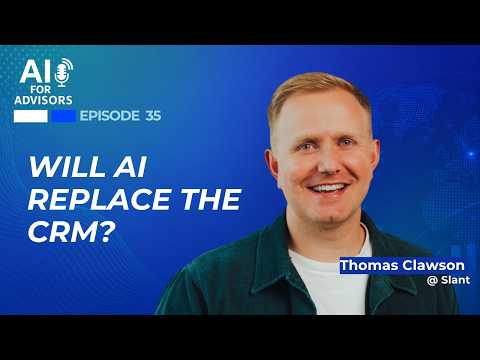
Will AI Replace the CRM? : Thomas Clawson @ Slant

Thomas Clawson · Slant CRM

1h 4mAug 6, 2026
Watch on YouTube
Most firms think AI changes software. The bigger shift is that AI changes workflows. As AI becomes the primary interface for getting work done, it's forcing firms to rethink a fundamental question: does the CRM still matter—or is it becoming obsolete? In this episode of AI for Advisors, James Cantwell and Mark Heynen sit down with Thomas Clawson, Co-Founder of Slant, to explore why AI-native software looks fundamentally different from legacy CRM platforms, what advisors actually need from a system of record, and why the future may be less about adding more technology and more about making existing workflows disappear. --- ### What You'll Learn * Why AI-native CRM isn't just legacy software with a chatbot attached * Whether AI agents will replace CRMs—or make them even more important * Why advisors still need a trusted system of record * How AI is changing client expectations before they ever meet an advisor * The tradeoffs between building specialized tools versus all-in-one platforms * Why customer experience has become a competitive advantage for advisor technology * How Slant went from marketing automation to one of wealth management's fastest-growing AI-native CRMs --- ### Key Takeaways **The CRM isn't disappearing** → AI changes how advisors interact with software, but firms still need a trusted source of truth. **AI shifts the focus from software to workflows** → The goal isn't more tools—it's fewer manual processes. **Great advisor technology reduces operational complexity** → The best platforms eliminate spreadsheets, disconnected apps, and repetitive work. **Clients are arriving more informed than ever** → AI isn't replacing advisors—it changes the conversations clients expect to have. **Relationships remain the competitive advantage** → AI can automate tasks, but trust is still built between people. --- ### Chapters 00:00 – Cold Open: Why Utah Produces WealthTech Companies 02:39 – Welcome & Introducing Thomas Clawson 04:10 – Should AI Be Regulated? 10:26 – The Story Behind Slant 18:18 – What Makes an AI-Native CRM Different? 26:27 – Will AI Replace the CRM? 35:35 – AI, Email & Advisor Workflows 38:02 – Building the Relationship CRM 41:46 – Should Advisors Build Software? 44:29 – Salesforce, Legacy Software & AI 48:25 – How AI Is Changing Client Expectations 52:31 – AI as an Educational Tool for Advisors 54:48 – Lightning Round 59:08 – Thomas's AI Stack & Waterboy 01:03:02 – Final Thoughts --- ### Why This Episode Matters The real question isn't whether AI replaces the CRM. It's whether today's CRM is designed for the way advisors will work tomorrow. As AI takes over more operational work, the firms that succeed won't necessarily have the biggest technology stack. They'll have systems that connect information, automate routine tasks, and help advisors spend more time where they create the most value: with clients. That's the conversation this episode explores.
The Future of AI Agents in Wealth Management: Freedom Dumlao @ Vestmark

Freedom Dumlao · Vestmark

46 minJul 17, 2026
Watch on YouTube
The more capable AI agents become, the less firms can treat them like ordinary software. An agent that can navigate systems, move information, communicate with colleagues, and take action begins to resemble an employee. That creates enormous leverage—but it also requires identity, permissions, oversight, and a clear record of what the agent did. Freedom Dumlao, CTO and Chief AI Officer at Vestmark, joins James Cantwell and Mark Heynen to explore how one of wealth management’s largest infrastructure providers is approaching that shift—from agent-assisted reconciliation to proactive advisor insights and virtual employees operating inside controlled environments. What You’ll Learn Why AI agents should receive permissions and oversight similar to human employees How computer-use agents change what is possible across disconnected systems Why task-specific tools make AI more reliable than prompting alone How workflow systems provide agents with memory, accountability, and audit trails Where agents can reduce manual work in reconciliation and portfolio operations How Vestmark Pulse turns market, portfolio, and CRM data into timely advisor actions Why governance—not technical capability—is the real constraint on enterprise adoption How fine-tuned models could outperform larger general-purpose models on specialized work Key Takeaways AI agents need employee-level governance → Separate identities, limited permissions, monitoring, and immediate access controls make autonomy safer. Tools matter more than memorized knowledge → AI becomes more reliable when it operates proven systems rather than generating answers from its training alone. The interface will move from dashboards to decisions → Agents can read underlying data, apply a framework, and surface the next action without requiring a human to navigate multiple screens. Workflow records still matter in an agentic system → Tickets and activity trails give agents memory while providing firms with visibility and regulatory defensibility. Specialized models may be the next efficiency advantage → A smaller model trained for one repeatable task can deliver greater speed and control than a powerful general-purpose model. Chapters 00:00 Why AI Agents Don’t Need Names 03:20 How Vestmark Powers Wealth Management 07:20 Freedom’s Path From Early Programming to FinTech 14:05 From Alexa to Vestmark 16:40 Building AI Safely Inside a Regulated Firm 19:42 When AI Can Control the Computer 20:49 The Security Risks of Computer Use 21:35 Treating AI Agents Like Employees 22:22 Why Tools Make AI More Reliable 26:12 Moving Beyond the AI Search Box 26:40 Should AI Preserve Existing Workflows? 28:02 Why Agents Still Need Workflow Systems 29:18 Memory, Observability, and Audit Trails 31:31 Redesigning Wealth Management Operations Around Agents 32:45 Agent-Assisted Reconciliation 34:44 Helping Advisors Scale Client Attention 37:21 Giving Virtual Employees Their Own Identities 39:27 Experimenting With OpenClaw and Hermes Safely 42:38 The Most Overhyped and Underhyped AI Tools 44:17 Turning Complex Information Into Timely Action 46:05 Why Note-Taking Is a Feature, Not the Product Why This Episode Matters The difficult part of deploying agents inside wealth management is no longer proving that they can perform useful work. It is deciding what they should access, how their actions should be observed, and when humans should remain responsible for the final decision. The firms that solve those management questions will be able to move beyond AI as an assistant—and begin redesigning how the work itself gets done. #AIForAdvisors #WealthManagement #FinancialAdvisors #RIA #AdvisorTech #WealthTech #ArtificialIntelligence #Vestmark
Why Advisors Should Stop Managing Portfolios: Jeff Coyle @ Libretto

Jeff Coyle · Libretto

48 minJul 9, 2026
Watch on YouTube
AI can make financial planning faster. But it cannot determine whether the planning methodology itself is sound. As firms focus on note-takers, assistants, and automation, a more important question can get overlooked: What value is the technology helping the advisor deliver? Jeff Coyle, founder and CEO of Libretto, joins James Cantwell and Mark Heynen to explain why financial planning should move beyond isolated portfolios, risk questionnaires, and Monte Carlo simulations toward a more complete view of the client’s wealth. What You’ll Learn Why a client’s investable portfolio may represent only a fraction of their total wealth How human capital, Social Security, property, insurance, and private assets change portfolio construction Why planning and investment design should operate as one connected process Where traditional Monte Carlo analysis falls short as a risk-management framework How AI can convert unstructured client documents into a working financial plan Why sophisticated planning methods may matter even more for mass-affluent clients What advisory firms underestimate when building technology internally Why advisors should strengthen their value proposition before automating its delivery Key Takeaways The portfolio is not the complete financial picture → Human capital, property, future benefits, liabilities, and insurance can matter more than the assets an advisor directly manages. Planning and investing should not be separate processes → Portfolio construction should reflect how the client will actually use their wealth throughout their life. Less-affluent clients have less room for error → Advanced planning methods are not reserved for ultra-wealthy families; their protection can be more consequential for ordinary households. AI should move the work forward → Extracting client data creates limited value unless the system can turn that information into analysis, recommendations, and action. Methodology comes before automation → AI can streamline an advisor’s value proposition, but it cannot compensate for one that is outdated or poorly defined. Chapters 00:00 Recording From Mexico City 01:27 Welcome to AI for Advisors 03:22 Introducing Jeff Coyle and Libretto 04:33 Should Advisory Firms Build Their Own Technology? 06:37 Managing Total Wealth, Not Just a Portfolio 08:11 Connecting Financial Planning and Portfolio Design 09:24 Moving Beyond Monte Carlo Risk 10:22 Who Libretto Is Built For 10:53 Why Total-Wealth Planning Matters at Every Wealth Level 13:04 Fixing Client Onboarding With AI 15:21 Turning Client Data Into Action 16:40 AI Grounded in Planning Methodology 18:27 Should Financial Data Stay in a Closed System? 21:18 Why Methodology Shapes the Answer 24:15 The Story Behind Mert 25:25 Challenging Traditional Financial Planning 27:04 Why Planning Methodology Has Barely Changed 28:29 The Broader Risks of AI Adoption 33:52 What Advisors Should Prioritize Before AI 37:01 Jeff’s Journey From Advisor to Founder 41:36 Wealth Management as Risk Management 42:29 The AI Tools Jeff Uses 44:02 The Most Overhyped and Underhyped Technology 47:01 Rethinking the Role of AI Note-Takers Why This Episode Matters The industry is spending enormous energy asking how advisors should use AI. That question begins too late. Advisors first need to decide what excellent advice looks like, which risks they are responsible for managing, and whether their current planning model reflects the client’s full financial life. Only then can AI make that value easier to deliver. Technology can accelerate the process. The quality of the advice still depends on what the process was designed to produce. #AIForAdvisors #FinancialPlanning #WealthManagement #FinancialAdvisor #RIA #AdvisorTech #WealthTech #Libretto #ArtificialIntelligence
AI Won't Replace Advisors—But It Will Change Them

Derrick Kinney & Matt Halloran · Success for Advisors & Zocks

1h 11mJul 2, 2026
Watch on YouTube
Advisors are no longer the only source of financial insight. Clients can arrive with research, questions, and even a financial plan generated by AI. Trying to prove the technology wrong puts the advisor in a losing competition. The better strategy is to treat AI as part of the relationship—and demonstrate the judgment, empathy, and accountability it cannot replace. Mike Barrasso of WealthReach and Matt Halloran of Zocks join James Cantwell and Mark Heynen to explore how AI is changing advisor growth, communication, and client service. Derrick Kinney of Success for Advisors joins midway through the conversation with a practical framework for combining better technology with more memorable human interactions. What You’ll Learn Why most advisory firms need a clearer identity before adding more marketing technology What advisors should actually do with the time AI gives back Why many firms use only a fraction of what their AI assistants can do How invisible technology can unintentionally make clients feel ignored Why personalized content still requires a genuine understanding of the firm How advisors can respond when clients bring them AI-generated financial plans Why gradual implementation works better than attempting a complete transformation Where virtual employees could reduce the cognitive burden AI currently creates Key Takeaways Advisors should not compete with AI → When clients bring AI-generated research, use it as a starting point and add the judgment needed to avoid costly mistakes. Efficiency is only valuable when the time is used deliberately → AI can create capacity, but the advisor must decide whether that capacity improves relationships, service, growth, or life outside work. Invisible technology still needs visible listening → Clients may not know an AI assistant is capturing the conversation, so advisors must continue showing that their words matter. Adoption happens through small changes → Firms are more likely to sustain progress by introducing one workflow at a time than by attempting a complete overhaul. AI raises the value of human interaction → As research and planning become more accessible, empathy, communication, and sound judgment become more—not less—important. Chapters 00:00 Naming an AI Assistant 02:14 Introducing Mike Barrasso and Matt Halloran 04:34 Why Advisor Growth Needs a System 06:20 Brand Before Technology 08:54 The Case for a Focused Niche 10:42 What Should Advisors Do With Saved Time? 15:39 Where AI Adoption Actually Stands 18:12 Beyond the AI Note Taker 20:41 Derrick Kinney Joins the Conversation 23:47 The Listening Hustle 25:53 Personalization Without AI Slop 31:17 What Actually Drives Advisor Growth 33:09 How Fast Follow-Up Wins Business 35:09 Why AI Adoption Remains Slow 38:29 Change Is the Real Implementation Problem 42:12 Can AI Coach Better Client Conversations? 45:27 Why Competing With ChatGPT Is a Losing Game 47:24 The Human Value AI Cannot Replace 51:51 Helping Resistant Advisors Get Started 56:47 AI as an Advisor’s “Super Suit” 59:57 Does AI Reduce Work—or Create More? 1:00:43 From Augmentation to Virtual Employees 1:02:35 The Most Overhyped and Underhyped AI Tools 1:09:32 Where to Find the Guests Why This Episode Matters Clients will increasingly use AI before speaking with an advisor. They may arrive more informed, more confident, and occasionally more mistaken. That does not eliminate the advisor’s role. It changes the starting point. The advantage belongs to advisors who can welcome what the client has already done, improve upon it, and provide the human judgment that turns information into a sound decision. Subscribe for more conversations at the intersection of AI and financial advice. #AIForAdvisors #FinancialAdvisors #WealthManagement #AdvisorTech #WealthTech #ArtificialIntelligence #FinTech

Know an advisor trying to make sense of AI?

Send them this. (They'll thank you later. Maybe.)

Featured Guests & Companies

Builders, operators, and AI nerds

Libretto logo
Success for Advisors logo
Zocks logo
WealthReach logo
Gridline logo
NeuBeFi logo
Advisor360° logo
RISR logo
SS&C Advent logo
FINNY logo

Coming Soon

Freedom Dumlao
Vestmark

Freedom Dumlao

Vestmark

CTO + CAIO

Thomas Clawson
Slant CRM

Thomas Clawson

Slant CRM

Co-Founder

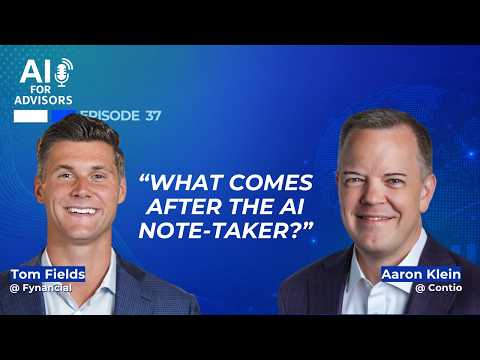
Aaron Klein
Contio

Aaron Klein

Contio

Founder

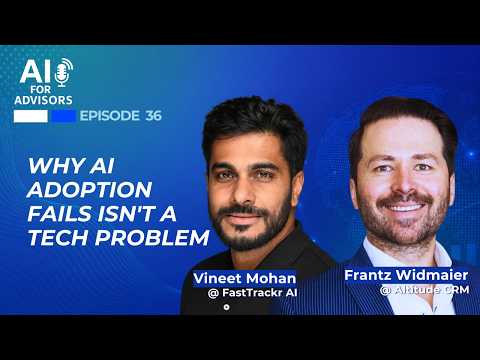
Frantz Widmaier
AL

Frantz Widmaier

Altitude CRM

CEO & Founder

Ian Karnell
VastAdvisor

Ian Karnell

VastAdvisor

CEO & Co-Founder

Tom Fields
Fynancial

Tom Fields

Fynancial

Founder

Vineet Mohan
FastTrackr AI

Vineet Mohan

FastTrackr AI

Founder & CEO

Be Part of the Conversation

Have a contrarian view on advisor tech, or building something that doesn't fit neatly into a Gartner quadrant? This show is for founders, operators, and practitioners who can talk candidly about what works, what flopped, and what they'd never ship again. If that sounds like you (or someone you know), pull up a chair.